Monday, 4 May 2020

Jerry Barker - Career Highlights

Hi All,

Just wanted to include a summary slide on my career highlights:


This shows the important milestones, in terms of R&D projects and commercial successes, I have enjoyed since my PhD in 1984. How time flies! My apologies for this being an eye-test - but just click on the image to get a full-size version (much easier to read!).

Cheers! Jerry

Wednesday, 22 April 2020

Faradion Press Release

Faradion receives first order of Sodium-ion Batteries for Australian Market

21 April, 2020: Faradion Ltd., the world leader in sodium-ion battery technology, has announced it has received its first order from ICM Australia for its high energy sodium-ion batteries for use in the Australian market.

Faradion’s Sodium-ion technology provides similar performance to conventional chemistries, while replacing expensive materials such as cobalt and lithium with the far more abundant sodium. Unlike lithium-ion batteries, Faradion’s sodium-ion batteries have exceptional thermal stability and safety. Further they can be safely transported and maintained at zero volts.

In recent years, Australia and New Zealand have demonstrated a steady uptake in battery storage in residential, commercial and grid scale applications due to factors including significant reductions in the cost of storage and solar systems; increasing cost of electricity, concerns about blackouts and financial incentives and policies from the government.

Speaking on this order from ICM Australia, Mr. Thomas Gregson, ICM Australia Investment Director said, “This order represents a first step for an Australian company to commercialise world leading sodium-ion technology, and we’re pleased to be offering a premium product that is safe and price competitive to the Australasian market.”

“We have seen large interest in energy storage solutions recently and believe the Faradion technology can provide, in a sustainable way, the energy security customers require at attractive ROIs,” Gregson adds.

Having seen significant interest in regions such as the US, Europe and India due to its performance, safety and price point, Mr. James Quinn, CEO of Faradion says Australasia was the next logical region for Faradion given the market conditions.

“Faradion is accelerating large scale industrialisation of its safe, low cost, Sodium-ion energy storage technology. In Australia, the market for energy storage is primarily for household battery technologies to complement solar photovoltaic installations, although the market for larger-scale energy storage is growing.

Australia is a perfect market for supporting Faradion’s growth in the rapidly expanding energy storage market and to speed up the transformation of the global energy market,” Quinn concludes.

ICM Australia expects a range of world class Faradion sodium-ion batteries to be available for the Australasian market later in the year.

-ends-

About Faradion Ltd:
Faradion is the world leader in Sodium-ion battery technology that provides low cost, high performance, safe and sustainable energy. Its proprietary technology delivers leading-edge, cost effective solutions for a broad range of applications; including mobility, energy storage, back-up power and energy in remote locations.

Faradion’s patented zero-volt capability, enables the safe transportation and maintenance of Sodium-ion batteries. The wide operating temperature range, high energy density and fast charge/discharge capability combine to offer a next generation, drop-in solution. Its Sodium-ion batteries contain no cobalt, no lithium and no copper, resulting in a safe and sustainable, cost-effective, high performance technology.   www.faradion.co.uk

About ICM Australia:
ICM is an Australian based privately owned business/investment group. The group specialises in developing businesses and brands in industrial products, food and agribusiness globally. www.icmaustralia.com.au .

For media queries, please contact:

Tom Gregson
ICM Australia
Level 2, 1 Collins St Melbourne
Tel: +61 3 9654 2300
James A. Quinn
Faradion Ltd
Mobile: +49 174 6069 007
Tel: +44 114 224 2421

Wednesday, 8 April 2020

Faraday Institution - SOLBAT

Dear All,

Here is the website for SOLBAT - the UK's Solid State Battery Project funded by the Faraday Institution:

https://www.solbat-faraday.org/


The ambition of this project is to demonstrate the feasibility of a solid state battery with performance superior to Li-ion in EV applications. With Oxford, university partners will include the University of Liverpool, University of Glasgow, University of Strathclyde, University of Cambridge, University College London, and the University of St. Andrews.


SOLBAT Schematic.png


I am a member of the FI's expert panel - representing the SOLBAT proect.

Jerry

Faraday Institution - NEXGENNA

Dear All,

Here is the website for NEXGENNA  - the UK's Na-ion Battery Project funded by the Faraday Institution:


https://www.nexgenna.org/


This project will accelerate the development of sodium-ion battery technology by taking a multi-disciplinary approach incorporating fundamental chemistry right through to scale-up and cell manufacturing. Its aim is to put on the path to commercialisation a sodium-ion battery with high performance, low cost, that has a long cycle life and is safe.


Faradion is a collaborator on the NEXGENNA project.

https://www.nexgenna.org/?page_id=476

Best Regards,


Jerry 

Thursday, 12 March 2020

IMLB-2020 - Berlin, Germany June 21-26, 2020


Hiya,

The list of invited speakers at the up-coming conference, International Meeting on Lithium Batteries, 2020 (IMLB-2020, June 21-26, Berlin, Germany) has now been posted:

https://www.imlb2020.org/front/content.php?id_article=344

Jerry Barker: The Commercialization of Safe, High Energy Density Na-ion Batteries

Friday, 24 January 2020

NEXGENNA: International Symposium on Sodium-ion Battery Technology


Hi All,

The agenda for the up-coming NEXGENNA Symposium on Sodium-ion Batteries has now been published. It can be found here:


Wednesday, 15 January 2020

Faraday Institution - NEXGENNA Project

Hi All,

Faradion will be involved in the Faraday Institution's NEXGENNA Na-ion battery project:

NEXGENNA - Delivering a revolution in cost-competitive battery technologies

Most current generation rechargeable batteries for transportation are based on the use of lithium. However, the relatively high cost, the somewhat limited global abundance of lithium, and environmental concerns around the sourcing of lithium mean that there is demand for a lower cost alternative that would increase the uptake of energy storage technologies in a number of sectors. Sodium-based batteries could be such an option, particularly for static storage, where cost is a more important factor than weight or performance.
This project will accelerate the development of sodium ion battery technology by taking a multi-disciplinary approach incorporating fundamental chemistry right through to scale-up and cell manufacturing. Its aim is to put on the path to commercialisation a sodium ion battery with high performance, low cost, that has a long cycle life and is safe.
Many models of future grid networks based on renewable energy incorporate storage on a local or domestic level for increased network resilience and to ensure efficiency of small-scale renewable sources. The widespread use of commercial Na-ion batteries, that this project will facilitate, would aid the realisation of these models, and also fulfil the need for low-cost electric transport options in the highly polluted and densely populated conurbations in developing economies.
More information may be found here:

Jerry

Thursday, 2 January 2020

20th International Meeting on Lithium Batteries (IMLB 2020)

Hi All,

Happy New Year to everyone!

I have been invited to give an oral presentation at the upcoming International Meeting on Lithium Batteries (IMLB 2020) in Berlin (June 2020).

https://www.imlb2020.org/

The IMLB is the premier international conference on the state of lithium (and sodium!) science and technology and is expected to draw more than 1000 delegates. It is intriguing that there is a special Na-ion session within the IMLB schedule - perhaps the organizers have seen the light!

The proposed title of my talk: The Commercialization of Safe, High Energy Density Na-ion Batteries.

I will have to demonstrate that Na-ion batteries are indeed the future! Safe, sustainable, outstanding performance plus zero lithium, zero cobalt and zero copper. What more do you need?

Here is the link to the list of invited speakers:

https://www.imlb2020.org/front/content.php?id_article=344

Jerry

Thursday, 28 November 2019

India is at the Energy Crossroads - Time for Na-ion Batteries

Dear All,

Another good article from India - highlighting the need to transition to electric vehicles and in particular the attributes of Faradion's Na-ion battery technology:

https://www.fairobserver.com/region/central_south_asia/india-electric-vehicles-sodium-ion-batteries-electric-cars-india-47938/

India should look at sodium–ion batteries more seriously. They work just like lithium–ion batteries, just with the lithium compounds swapped with sodium compounds. Sodium is one of the abundant elements on Earth, with vast global reserves of sodium minerals for example from seawater.
Research interest in sodium–ion batteries really took off from 2011. Until 2010, there were only 115 scientific papers ever published on such batteries by 2010. In the subsequent nine years, this number grew 50-fold to reach 5,804.
There are just a handful of companies working on this technology. The first to commercialize it, the UK-based Faradion, has filed multiple patents on sodium nickel and manganese-based oxide cathodes that do not contain any cobalt. Manganese and nickel are both abundantly available. The energy density of these sodium–ion cathodes has been shown to be almost similar (⁓80%) to that of NMC lithium–ion cathodes.
Sodium-ion batteries also have the significant advantages of being easier to recycle and transport. Lithium-ion batteries always need to be stored or transported at a partially or fully-charged state, where a battery is at its most unstable state. This is why there are global regulations that tightly dictate how lithium-ion batteries can be transported (why you can’t check-in such batteries in the luggage hold at the airport, for example).

Friday, 15 November 2019

Can Sodium-ion Batteries Propel the Future of Clean Transportation?

Dear All,

A new article on Na-ion Batteries has been written by my colleague at Faradion, Dr. Ashish Rudola:

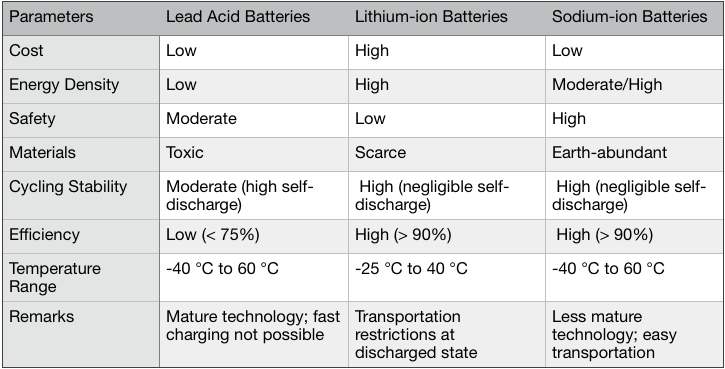
https://evreporter.com/sodium-ion-batteries/


This level of technological maturity for sodium-ion batteries has been achieved in just eight years – with a few more years of similarly rapid development, the signs are indicating that the energy densities of commercial sodium-ion batteries would be comparable to those of NMC-based lithium-ion batteries. In the near future, it is realistic to expect that sodium-ion batteries would break through into the long-range EV market.